
Attract top talent and reduce turnover by making every day a payday for your employees.
Attract top talent and reduce turnover by offering earned wage access.
Provide employees with financing when they need it to increase their satisfaction.
Relieve employees' financial stress and help them meet their personal needs.
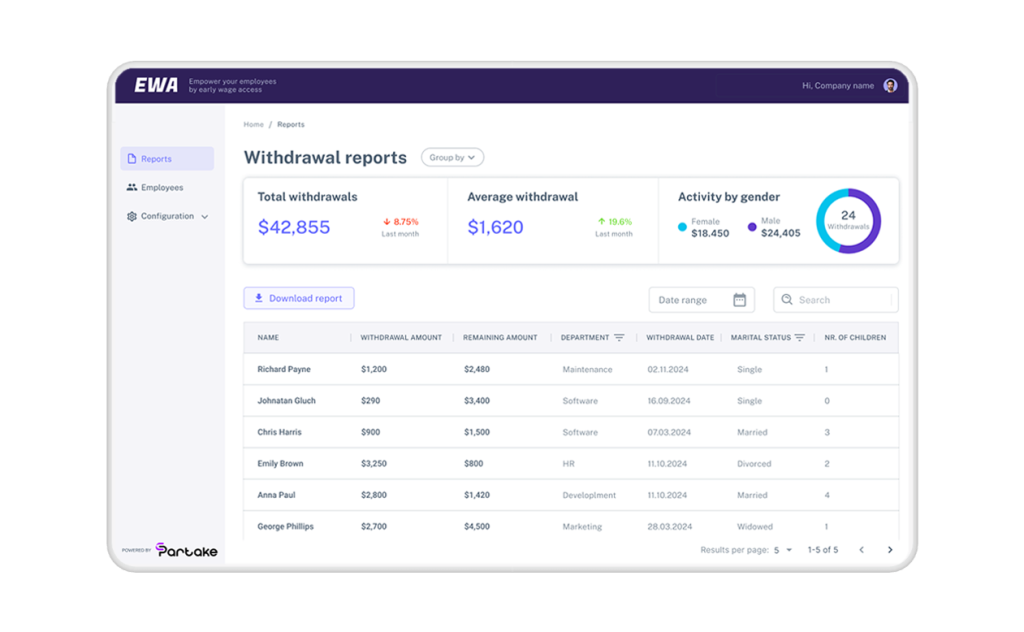
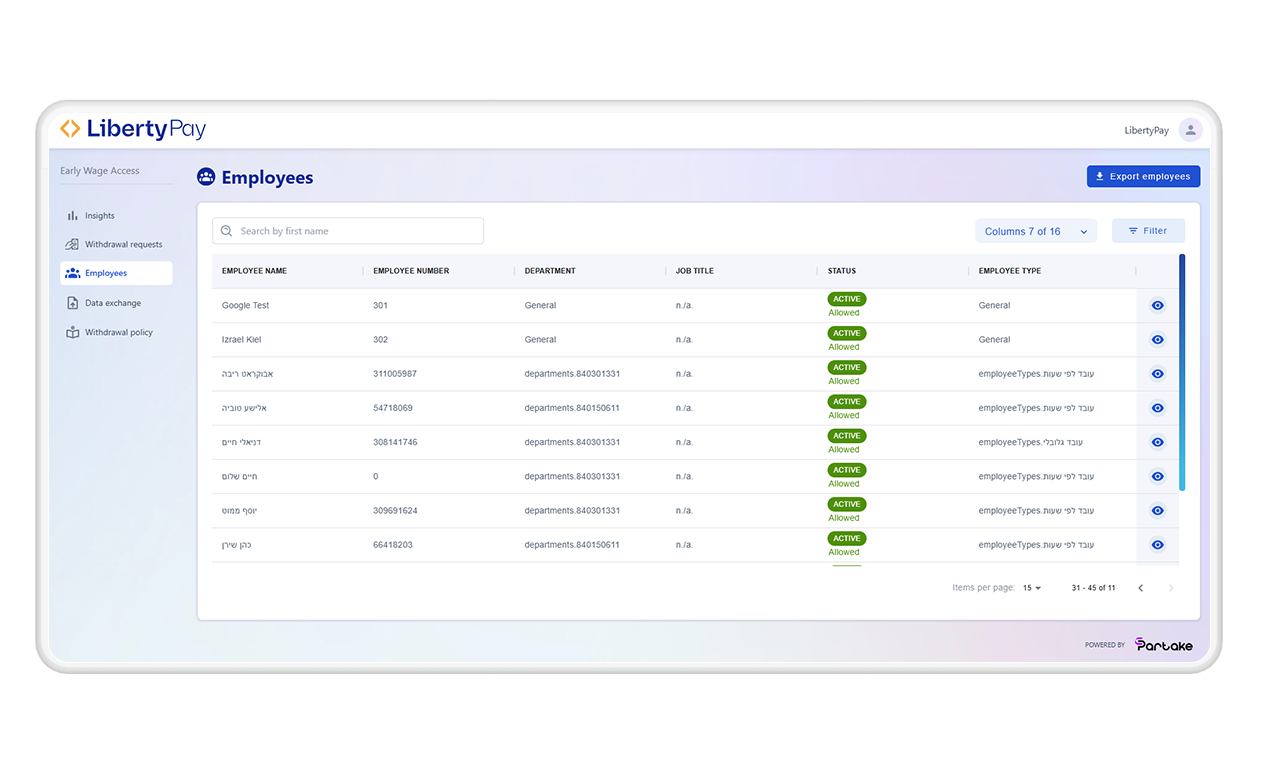
The Earned Wage Access (EWA) allows employees to access their already earned wages on-demand, before a traditional pay cycle. It can also be referred to as salary on-demand, instant, or early pay.
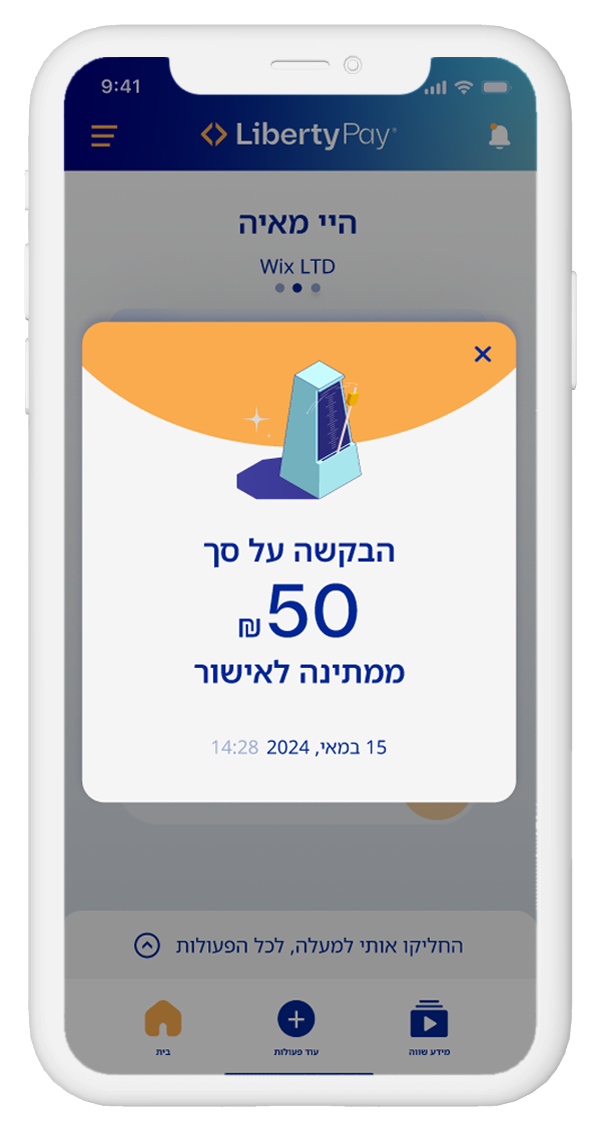
Employees can easily request their earned wages using our mobile app when they need it. The amount available depends on the individual’s regular compensation and the number of hours they have worked during the pay period.
The early-paid wages is automatically deducted from the next payroll amount so the company should not take any additional action to procced with the money movement.
The Covid-19 pandemic has led to a deterioration in the well-being and solvency of millions of people around the world. This gave additional impetus to the development of earned wage access (EWA) or pay-on-demand startups as an alternative to traditional finance. Activation of deals and growth in the volume of financing forced many experts to talk about this segment as one of the most dynamic and investment-attractive.
The business gradually moved away from the strict “pay on the 5th and 25th of every month” schedule. Many people want to get paid every day because of the pandemic. Today, fintech startups specializing in pay-on-demand or early wage access services around the world are actively responding to this trend.
What is important: “pay-on-demand” is mostly not associated with banks. These services provide for transferring money directly through financial services, to which employers compensate this money from their budgets. This can be the money of both the startups themselves and third-party investors. The business model of earned wage access is based on receiving income from commissions or monthly subscription fees paid to the startup by customers – the staff of business structures.
Interaction with stakeholders takes place through an online platform or a mobile app. At the same time, pay-on-demand is a low-risk business. Salaries on demand paid to staff are covered on certain dates by employers contracted by fintech startups.
Early disbursement of money increases the efficiency of employees and has a positive effect on the economic situation of the company. The ability to receive money at any time for unforeseen expenses (treatment, repairs, etc.) reduces the level of stress.
Pros of the access wage early:
Cons of the early wage access:
According to several experts, pay-on-demand startups represent the greatest value in sectors with relatively low wages: hotel business, catering, restaurant sector, retail, etc.
The company signs a contract with a startup. After that, a plug-in is added to the accounting system of the business structure, which transfers the service information about connected employees, their salaries, sick leave, vacations, dismissals, etc.
According to the agreement, the employer transfers the payments due to employees not directly but through the pay-on-demand service, which, when the employee applies, can make the payment earlier, at their own expense, after which they are guaranteed to receive this money from the employer and close the resulting debt.
For such a service, the service takes a commission for each application for early payment of salaries. Sometimes, it charges interest on the amount received in advance, depending on the conditions of a particular service. But in any case, it turns out to be significantly more profitable than using microloans, which are known as payday loans. On average, the client’s expenses for paying for pay-on-demand services are ten or more times lower than for paying for microloans.
Through such services, you can receive a salary ahead of schedule, not in full, but in some large part, as a rule, this is 70-80% of the due payment.
To use the service, willing employees install a mobile application in which all the data is visible: when the salary arrives, when it can be received ahead of schedule, in what amount, how much you need to pay, etc. You can get a salary ahead of schedule immediately through the application without filling out any applications, submitting any documents, or applying anywhere. In addition, the issuance of wages ahead of schedule through such services is not considered a loan and therefore does not affect the credit history in any way.